Why a six-storeys rental does (or doesn't) pencil in 2026
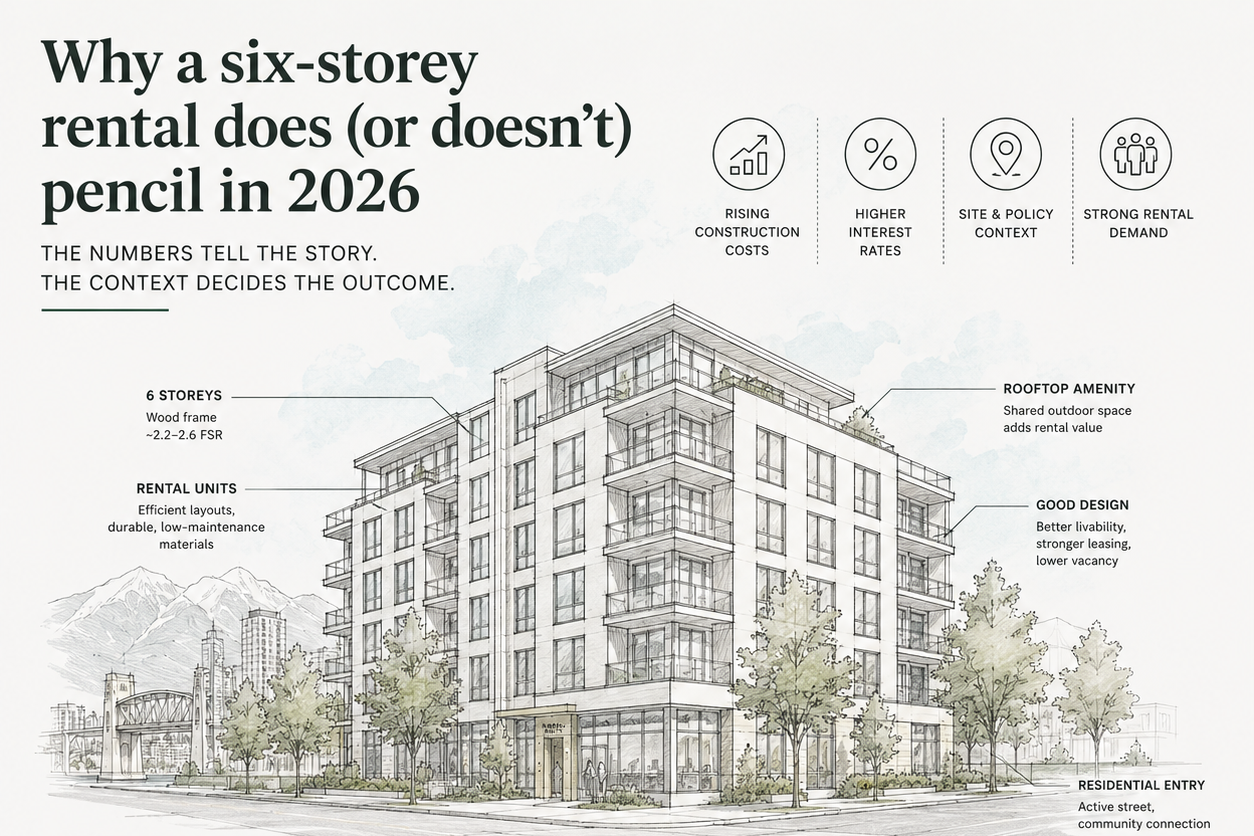
Vancouver keeps loosening the rules for six-storey rental buildings — not out of generosity, but because rising costs are threatening to stall them. Here's the development math, and what the city is doing about it.
Zoning tells you what you're allowed to build. Economics tells you whether it will actually get built. In 2026, plenty of six-storey rental buildings that are fully permitted on paper aren't breaking ground — because the numbers don't work. Understanding why is the difference between a site that pencils and a hole in the ground that never happens.
"Penciling" is developer shorthand for the moment a project's expected value comfortably exceeds its total cost — enough to cover risk and attract financing. Right now, for a lot of wood-frame rental, that margin has gotten thin.
The cost side is squeezing

Wood-frame residential construction in Metro Vancouver runs roughly $400–$450 per buildable square foot in early 2026, with about $425 as the common midpoint — up from around $380 in early 2024. Material costs alone have risen 3–5% since early 2025, driven largely by tariffs on imported steel, aluminum, and some engineered wood products.
Layer on today's higher interest rates and the picture gets tighter still, because a development loan carried across a long timeline is pure cost. The result is a per-unit cost basis that ranges from around $750K on the cheaper edges of the region to well over $1.5M on Vancouver's West Side. Against the rents those units can command, margins are workable in some locations and simply don't clear in others.
What actually determines whether it pencils
Strip away the jargon and a rental pro forma comes down to a handful of levers:
| Lever | What moves it |
|---|---|
| Achievable rent | Location, unit mix, and market — the revenue ceiling. |
| Hard construction cost | ~$425/sq ft and rising; the biggest single number. |
| Land cost | What you paid — often the swing factor between go and no-go. |
| City charges | Development cost levies and amenity charges per buildable foot. |
| Financing & time | Interest rate × how long your money is tied up before rent starts. |
Because construction and financing costs are largely outside a developer's control, the two levers that most often decide a project are what you pay for land and what the city charges. That second lever is exactly where policy has been moving.
What the city is doing about it
Recognizing that projects were stalling, Vancouver has rolled out a set of measures aimed squarely at viability:
A temporary 20% discount to the city-wide, utilities, and area-specific development cost levies — estimated to cut city-wide development costs by $75–100 million — pending a new "Financing Growth" framework. A two-year Rental Development Relief Program offering a full waiver of the city-wide DCL on the residential portion of qualifying mid- and high-rise rental buildings. Proposed zoning changes to expand the districts where six-storey rental is allowed without a below-market housing requirement in most cases. And relief on affordability conditions for a batch of stalled rental projects to get them moving.
The takeaway
A six-storey rental in Vancouver in 2026 is a fine-margin business: construction near $425 a foot, financing that punishes delay, and a shifting stack of city charges. What tips it from "doesn't pencil" to "does" is usually disciplined land pricing and taking full advantage of the relief programs currently on offer — several of which are explicitly temporary. For anyone weighing a rental project, the window and the fine print both matter, and the underwriting deserves a careful look before the land is committed.